Return to the Feature Index.
Return to the Main Index.
Introduction.
-
Sometimes there just isn't enough information on electric instruments
and amps to allow them to be properely dated. And
many people ask me to try and determine the year of their old amplifier,
or to help them with the year of their older off-brand electric guitar.
Since I primarily collect amps by Fender, and guitars by Gibson, Fender, Martin, National, Epiphone, Gretsch and Rickenbacker, I really can't help them with these other less popular brands. As you have probably noticed, there is plenty of information here to help date the brands that I am interested in. But where does that leave everyone else?
Well I'm not one to leave you out in the (informational) cold, so here's something that I use quite often in dating amplifiers and electric guitars. It's called the "source-date code", and it can help determine the approximate age of an electric instrument by the date its components were manufactured.
-
On American made vintage gear, the pots and speakers provide an excellent
opportunity to date a piece of equipment by referencing their "source-date
code".
The source-date code found on pots and speakers gives the manufacturer and date (roughly) when the components were made. It may have been some time before the part was installed at the factory, but it still provides a good approximation of when the gear was made. This is especially helpful on (less popular) gear that doesn`t have reliable serial#`s or other information to date them.
The source-date code will signify the earliest possible date that the instrument or amp could have been made. This isn't going to be exact, but it will give you a "ball-park" age. And remember, even the dates indicated by the pots aren't that exact. For example, if you buy a brand new CTS pot today, they are dated a month or two in advance! It's worth mentioning since a lot of people rely on pot dates.
That said, it's not uncommon for pot manufacturers to post date pots anywhere from a few weeks to as much as 18 months. (The standard today is no more than 18 months, but back in the 1950s and 1960s, who knows?) Some large parts distributors would even return parts if the date code was "expired" and want "fresh" parts in return. This seems silly, as we're talking about electronic parts not eggs. But if you think about it, parts like electrolytic cacpacitors, this could be an issue. Then the parts maker (like CTS) would have to eat the returned inventory, or sell it off to someone that didn't care about date codes, and probably at a discounted amount. What I'm saying is that pot and capacitory date codes are not a reliable indicator of guitar build dates. Though they are one piece of the puzzle and something to consider, don't put too much faith into a pot date.
The source-date codes are under the framework of the "Electronic Industries Association", which is a non-profit organization representing the manufacturers of electronic parts. The EIA source-date code is a numeric code, assigned and registered by the EIA. It can be stamped or marked on any product to identify the production source (vendor) and date of manufacturer. Source-date codes have been published by the EIA since 1924. The EIA can be contacted via mail: Electronics Industries Association, 2001 Pennsylvania Ave NW, Washington, D.C. 20006.
- Source-date codes weren't an industry standard until after WWII. But I have seen them used on Stackpole pots on electric National guitars as early as 1935. The first time date-source codes were published was 1924, so I guess you could see them as early as the late 1920's.
- Most Fenders from 1966 to 1969 have 1966 dated CTS pots. Apparently CBS/Fender bought a large stock of pots in 1966 that lasted till 1969.
- On popular Fender models, the pot date can be very close to the actual date of the instrument. On less popular Fender instruments, such as LapSteels, pots can be as much as two years earlier than the actual date of the instrument.
- Gibson didn't start using pots with source-date codes till 1953 or 1954.
Originality.
-
Of course this all assumes the pot or speaker is original. You have to make that
call. I would suggest checking the solder joints - are they clean?
Are the wires of the right era (cloth insulation for older stuff)?
If so, you can check the pot or speaker for the source-date code, and
determine an approximate age from that.
-
The source-date code on a pot is a 6 or 7 digit code impressed
into the casing of the potentiometer. For speakers this code can be
5, 6, 7 or 8 digits long, and it's ink-stamped or
paint-stamped on the "bell housing" of the speaker.
- Sometimes there is a space or hyphen between the manuafacturer code and the year/week code.
- 3 digit date codes were used in the 1940's and 1950's. Stackpole for example converted from three to four digit date codes in late 1959.
- 4 digit date codes were used in the 1960's and later (this makes determining the year much simplier!)
- On 3 digit date codes, you have to "guess" the decade of the pot or speaker. Usually this isn't too difficult.
In either case, the code works the same. The first 3 digits on a pot, or the first 2, 3 or 4 digits on a speaker are the source or manufacturer code.
The remaining 3 or 4 digits are the date code. In 3 digit dates code, the 1st digit is the last digit of the year. On 4 digits date codes, the 1st and 2nd digits are the last two digits of the year. In either case, the remaining 2 digits are the week of manufacture (01 to 52). With this in mind, remember if the last two digits of the source-date code are greater than 52, you're not looking at the source-date code!
Also it's worth mentioning:
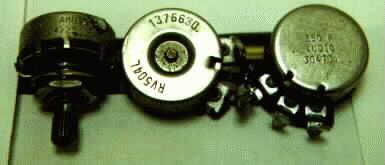
Pots used by Fender. The middle one is a CTS pot (Chicago Telephone Supply, manufacturer #137)
from the 30th week of 1966. The pots on the left and right are Stackpole pots
(manufacture #304). Note the different position of the markings, even
on pots from the same maker.
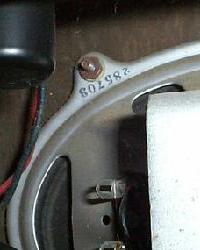
Left: The source-date code (285709) on a speaker. In this case, the speaker
is made by Rola (285) in the 9th week of 1957 (709). The decade, though
not directly shown by the source-date code, was easily determined because
this particular amp was only made during the 1950s. Note the font style
of the source-date code number always seems to be the same, for all speaker
manufacturers.
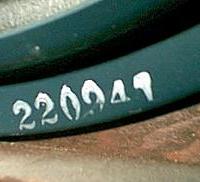
Right: Same thing here. Jensen (220) speaker made in the 41st week of 1959 (941).
-
Here are the most common pot manufacturers (the first 3 digits of the
source-date code):
- 106 = Allen-Bradley
- 134 = CentraLab
- 137 = CTS (Chicago Telephone Supply, pots and speakers)
- 140 = Clarostat
- 304 = Stackpole
- 381 = Bourns Networks
- 615 = IRC (International Resistive Company) - see below
Fender Products.
-
During the 1950's, Fender used mostly Stackpole (#304) pots. Then in roughly early 1963,
they changed to CTS (#137) pots. In 1967 (after CBS bought Fender), Fender bought
a HUGE supply of pots from CTS. This supply lasted for over five years. So guitars and
amps made as late as 1973 can still have 1967 date codes from this huge 1967 stocking.
All during Fender's life as an amplifier maker, then used speakers made by Jensen (#220), CTS (#137), Oxford (#465), Utah (#328) and Altec-Lansing (#391). Till about 1961, Jensen was the only Fender speaker supplier. Then from 1962 and later you see Fender using speakers from all the above mentioned makers.
National, Valco, Supro Amplifier Products.
-
Note the use of "550" as a source code on these products. Actually, it's not a source code
but is a manufacturers code for all
National, Valco, Supro products. Found as second stamping on speakers as a
date code 550XXX from 1947 through the 50's and 60's (all the 1940's amps
are generally field coil Rola spkrs).
Manufacturer Source Codes.
Below are many manufacturer source codes (which are the first 2,3, or 4 digits
of the source-date code).
-
Common Guitar Speaker Manufacturers:
- 67 = Eminence
- 137 = CTS (Chicago Telephone Supply)
- 220 = Jenson
- 285 = Rola
- 308 = Stromberg-Carlson
- 328 = Utah
- 336 = Western Electric
- 391 = Altec-Lansing
- 416 = Heath
- 465 = Oxford
- 589 = Bogen
- 649 = Electro-Voice
- 24 = Becker
- 101 = Admiral
- 106 = Allen-Bradley
- 119 = Automatic mfg.
- 125 = Bendix
- 130 = Panasonic
- 132 = Talk-a-Phone
- 145 = Consolidated
- 150 = Crecent
- 169 = Hitachi
- 185 = Motorola
- 188 = General Electric
- 213 = Dearborn Wire
- 230 = Littlefuse
- 232 = Magnavox
- 235 = Mallory - North American Capacitor
- 244 = Muter
- 245 = National
- 251 = Ohmite
- 252 = Dukane
- 258 = Perm-O-Flux
- 260 = Philco
- 270 = Quam-Nichols
- 274 = RCA
- 277 = Emerson
- 280 = Raytheon
- 300 = Speer
- 381 = Bourns
- 285 = Rola
- 286 = Ross
- 296 = Solar
- 312 = Sylania
- 336 = Western Electric
- 343 = Zenith
- 371 = Best
- 374 = Cletron
- 394 = Foster Transformer
- 423 = North American Philips (Norelco)
- 433 = Cleveland
- 449 = Wilder
- 466 = Delco
- 532 = Ward Leonard
- 549 = Midwest
- 555 = Waldom Electronics
- 575 = Heppner
- 649 = Electro-Voice
- 706 = Pioneer
- 719 = Carbonneau
- 722 = Milwaukee Resistor
- 742 = Esquire
- 748 = Russell
- 756 = Universal
- 767 = Quincy
- 787 = Sonatone
- 789 = McGregor
- 794 = Harmon Kardon
- 795 = Atlas
- 816 = Dale
- 828 = Midland
- 840 = Ampex
- 847 = University
- 918 = Oaktron
- 932 = Atlas
- 1056 = Fisher
- 1059 = Channel
- 1098 = Pyle
- 1113 = Acoustic Fiber Sound
- 1149 = Curtis Mathes
- 1191 = Micro Magnet
- 111 = Amperex (USA)
- 125 = Bendix
- 158 = DuMont
- 185 = Motorola
- 188 = General Electric Co (USA)
- 210 = Hytron (CBS-Hytron)
- 260 = Philco
- 274 = RCA (Radio Corp of America)
- 280 = Raytheon
- 312 = Sylvania (Hygrade Sylvania Corp)
- 322 = Tung-Sol
- 366 = Western Electric
- 337 = Westinghouse
- 343 = Zenith Radio Corp (CRT's)
- 466 = Delco
- 980 = Texas Instruments
- 102 = Aerovox Corp
- 109 = American Condensor
- 134 = Centralab
- 135 = Chicago Condensor
- 163 = Aerovox Hi-Q Division
- 178 = John E Fast
- 188 = General Electric
- 235 = Mallory
- 240 = Micamold
- 242 = Millen
- 273 = Radio Condensor Company
- 296 = Solar
- 303 = Sprague (every Gibson lover's favorite!)
- 438 = Gudeman
- 446 = Good-All
- 461 = Barker & Wiiliamson
- 472 = Pyramid
- 516 = United Condensor
- 569 = Electrical Utilities Corp
- 616 = Illinois Capacitor (Condensor)
- 648 = American Radionic
- 658 = Sangamo
- 705 = Ajax
- 710 = Standard Condensor
- 732 = RMC (Radio Materials Corp)
- 885 = Condensor Manufacturers
- 138 = Stancor (Chicago-Standard)
- 141 = Coil Engineering
- 172 = Ensign Coil
- 183 = Freed
- 194 = General Radio
- 218 = Jefferson Electric
- 238 = Thordarsen-Meissner
- 239 = Merit Coil & Transformer
- 305 = Standard Coil
- 352 = Essex (Transformer Division)
- 366 = New York Transformer
- 391 = Altec Lansing-Peerless
- 394 = Foster Transformer
- 412 = General Transformer
- 418 = United Transformer Corp (UTC)
- 489 = Radio-Television Products Corp
- 452 = Empire Coil
- 503 = Caledonia
- 524 = Triwec Transformer
- 549 = Midwest Coil & Transformer
- 550 = Standard Winding Co
- 572 = F & V Coil Winding
- 606 = Woodward-Schumacher
- 637 = Central Coil
- 682 = Electrical Windings
- 757 = Grand Transformers
- 773 = Forest Electric
- 776 = Ogden Coil & Transformer
- 830 = Triad
- 831 = Better Coil & Transformer
- 843 = Klipsch
- 878 = Acro Products (Acrosound)
- 883 = Mohawk
- 892 = American Transformer
- 897 = Tresco
- 906 = Coilcraft
- 908 = Aerocoil
- 928 = Acme Coil & Transformer
- 933 = Magnetic Coil Mfring
- 934 = Oaktron
- 1005 = Northlake
- 1052 = Pacific
- 139 = Cinch (Sockets, connectors)
- 152 = Crosley (Radios)
- 194 = General Radio (Test Equip)
- 199 = Hallicrafters (Ham & SW gear)
- 222 = E F Johnson (Sockets, ham xcvrs)
- 248 = Arvin (Sears radios & TVs)
- 254 = Packard Bell (TVs radios computers)
- 260 = Philco (Radios & TVs)
- 262 = Philmore (Hardware)
- 277 = Emerson (Radios & TVs)
- 343 = Zenith (Radios & TVs)
- 416 = Heath (Electronic kits)
- 772 = Muntz (Cheap TVs)
- 787 = Sonotone (Phono cartridges)
Some tidbits on Jensen: Fender used Jensen speakers until 1972 when all Jensen production (and one engineer) was switched to The Rola Company in Cleveland OH (Rola was a division of Jensen). Prior to the re-structuring of Jensen in '71-'72, Jensen quality had suffered terribly. When Rola started to make speaker for Jensen in 1972, Rola initially used the Jensen 220 manufacturer code, but by the end of 1972 changed to the 285 Rola code. Regaining OEM customer confidence after the Jensen years was a long process due to the Rola-Jensen ties.
Other Speaker Manufacturers (thanks to P.Bechtoldt and H.Murphy):
Tubes/Transistors Codes
Capacitor Codes:
Transformers & Coil Codes:
Other Manufacturers
Examples of Source-Date Codes.
-
With all this information in mind, can you identify the following
manufacturer and date of these source-date codes?
- 220 7001
- Jensen speaker, 1st week of 1970.
- 137341
- CTS, 41st week of 1953 (or 1943 or 1963, but probably 1953 as source-date codes weren't used much during or before WWII, and 4 digit date codes weren't used till the 1960's and later).
- 304-6110
- Stackpole pot, 10th week of 1961.
- 137848
- CTS, 48th week or 1948 or 1958.
- 4656755
- Not a source-date code. Can you see why? If you can't, read the above information again!
Here's another example:
^^------- week of year (01 through 52), in this case 9th week
^--------- last digit of year (0 through 9), in this case 1958
^^^---------- manufacturer's source code, in this case Stackpole
IRC Pots (as used on many Gibson Les Pauls).
-
IRC (International Resistive Company) used a different source-date code
system. For example, here's a typical 1950s IRC code seen on a 1955 Les Paul Junior pot:
^^^----------------- 615 is the source code for IRC
^^^^------------- 4190 is IRC part# (0689 & 2632 also common)
^^^^-------- 500k is the pot value in ohms
^------ last year's digit (0 t0 9), hence 1955
^^---- week (01 to 52), hence 43rd week
Jensen Speaker Codes.
-
Jensen was a very popular maker of guitar amplifier speakers
during the 1950s and 1960s. Fender and Gibson used them, and
did many other makers. There are some other codes used on
Jensen speakers, as shown below. The first set of codes
shows the type of magnet, size and quality of
the speaker.
- F = "Field" magnet, which is a powered magnet (often with a small transformer mounted on the speaker).
- EM = Electro Magnetic or Electronic Musical (electronic musical instrument speaker, 6"x9" to 15")
- P = "Permanent" magnet, Alnico V. At some point in the 1960s Jensen stopped using Alnico V magnets (and used ceramic magnets instead), but kept the "P" prefix!
- PM = Permanent Magnet, mostly AlNiCo type (or other earth metal combinations)
- C = ceramic
- NEO = Permanent Magnet NIB type (newest variety)
- Professional series: letters J,K,L (made in 18" and 15" sizes only).
- Concert series: letters N,P,Q,R (made in 8", 10", 12", 15" sizes). Best for guitar amps.
- Standard series: letters S,T,U,V,W,X (codes U,W,X only came 8" and smaller).
- CBA-811-1053: circa 1965 (Gibson parts list)
- CBA-811-1831: circa 1965 (Gibson parts list)
- CBA-811-1158: late 1960s.
- C-70-05675-0: circa 1965
- CBA-5124: circa 1965
- CBA-811-3701: unknown date
- CBA-811-3703: unknown date
- 70020: circa 1971 & 1977 Gibson parts list
- 70028: circa 1978-1981 Gibson parts list
- 70035: circa 1981 Gibson parts list
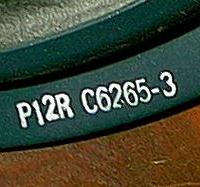
The "P12R" identifies the type of
magnet, the size, and the quality
of the speaker.
The prefix code letter identifies the type of magnet used in the speaker. Prior to the 1950s, Field or ElectroMagnetic magnets were used. Instead of a permanently magnetic magnet, electricity was used to make the magnetic field. These became obsolete with good Alnico magnets and weren't used much past the 1940s. For the best guitar tone, it is generally agreed "permanenent" Alnico V was the magnet of choice. AlNiCo was the mainstay for decades because it produced a strong magnet which worked great in speakers. It was largely discontinued because of higher cost compared to newer materials (there are other rare earth metals now, such as samarium-cobalt and neodymium-iron-boron aka NIB that are now often used). Also Ceramic magnets were cheaper to make than Alnico, hence their usage in the 1960s instead of Alnico.
Here are some of the Jensen prefix codes:
The number is the size of the speaker. Jensen made speakers from 4" to 18" sizes.
The suffix code letter identifies the quality of the speaker. Jensen speakers came in varying quality levels. They had a Professional series, a Concert series, and a Standard series. The closer the suffix code letter is to "A", the higher the quality of speaker. For guitar amplifiers, the Concert series is considered the best (the professional series is too efficient and doesn't "break up", the Standard series is too whimpy and can't handle any power). Here are the series code letters:
Gibson Anolomies.
Gibson used some pots with strange codes during the 1960s that were confusing.
These codes don't make a lot of sense, so are noted below.
Gibson /
Fender /
Martin /
Gretsch /
Epiphone /
National
Rickenbacker /
D'Angelico /
Hofner /
Kay /
Danelectro /
Dobro
Picture Gallery /
Home