Gibson PAF (Patent Applied For) Humbucking Pickup Info.
If you have an original Gibson PAF pickup and/or M-69 pickup ring for sale, please let me know by going to my Contact web page.
Gibson solidbody vintage guitars history and collecting. Private vintage guitar collector. Pictures, history for Gibson solidbody vintage guitars.
Picture Gallery, Gibson section.
Gibson General Info.
Contact the vintage guitar info guy.
Because of the amount of "bogus" PAF (Patent Applied For) Gibson humbucking pickups out there, I was asked to create this web page (thanks to GW Dean and BurstMeUp for information and pictures). This web page includes information on the pickups themselves *and* their plastic mounting rings. The originality of the pickups and their mounting rings are both important factors in the integrity of a vintage Gibson guitar.
There are some basic facts that should be known about these first-generation humbucking pickups. First PAF pickups came about in 1956 on Gibson console steel guitar models (8 string models), and about February 1957 on many Gibson spanish 6 string guitar models. The PAF lasted to about 1962 to 1965. Nickel plated part models transitioned away from PAF pickups first around 1962, since these guitars were sold in greater numbers. Gold plated part guitars can often be found with PAFs (or one PAF and one Patent# pickup) as late as 1965. PAF guitar 6 string pickups of course have two internal coil bobbins under a 1.5" x 2.75" metal cover with one bobbin having a row of six adjustable slot-head poles, and the other bobbin being non-adjustable.
PAF History.
I guess we should start with a little history of the Gibson PAF pickup.
By the mid-1950s, Gibson wanted to counter the latest electric guitars introduced by
Fender. Leo Fender had built a company that was a sizable competitor
in the solid-body guitar market place. Gibson believed
they could beat Fender with their high quality Les Paul, and
by developing a low-noise pickup.
The problem with Gibson's P-90 and Fender's single-coil pickups was inherent in their designs, allowing 60-cycle hum (noise) to interfer with the sound. Seth Lover was the Gibson engineer assigned to solve the problem. Seth connected two single coil pickups in series (opposed to parallel) and connected the coils out-of-phase electrically and magnetically. Thus the signal noise of each separate coil canceled out the noise of the other coil. That is how the pickup came to be known as a "humbucking" or "humbucker" (noun).
1956 PAF as used on Gibson console steel guitars.
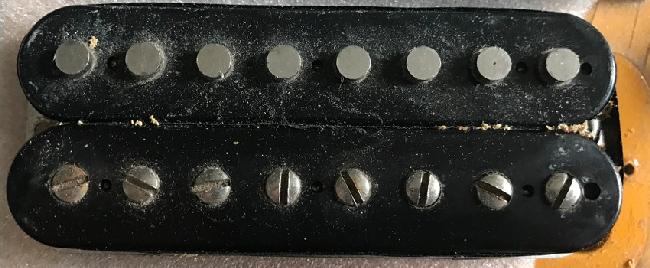
The 1956 first generation Gibson humbucking pickups is not the six-string PAF we would recognize today. Being an eight-string model, with individual magnetized poles, not a bar magnet running the length underneath. The bobbins look similar to the 6 string PAF bobbin, but obviously for eight strings instead of six. The base plate was totally different, as was the cover. Production 6 string guitars got PAFs in February 1957. Nothing existed before this in 6 string format.
Seth/Gibson filed their patent for the pickup design on June 22, 1955. Gibson added the new pickups to console steel guitars in 1956, and in February 1957 on electric solid-body and arch-top guitars including the Les Paul Model. The ES-175 was the first model to get PAF six string pickups. Pre-decal PAFs (unlabeled) existed from February 1957 to mid/late 1957. During late 1957, a small black decal with gold lettering was added to the underside of the pickup that read, "PATENT APPLIED FOR" (hence the PAF abbreviation). At some point the UltraTone lapsteel got a PAF too, but this was more likely in 1958.
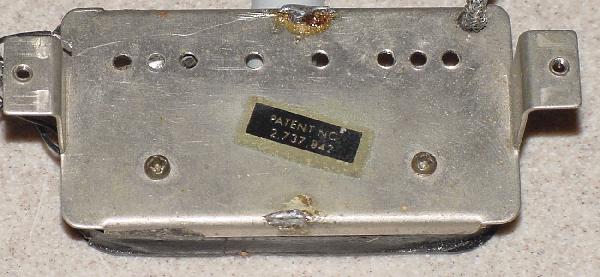
Seth Lover received his pickup patent #2,896,491 on July 28, 1959. By mid to late 1962, Gibson changed the pickup decal to read, "PATENT NO 2,737,842". Interestingly the patent number listed on the decal was not for Seth's pickup design but was for Les Paul's trapeze tailpiece! Perhaps this was a research roadblock for the competition, or maybe just a mistake?
PAF Magnets.
From 1956 until 1961 Gibson used different Alnico magnets in their PAF pickups.
Alnico magnets (alloys ALuminum, NIckel, and CObalt) come
in a different grades based on their magnetic strength. Gibson generally used the same
magnets (size/grade) which was available for their P-90 pickups. But Gibson randomly used
Alnico 2,3,4,5 grade magnets in PAFs until 1961 (remember the higher the magnet's number,
the higher the magnetic strength). This can often account for how two PAF pickups
can sound quite different. In July 1961 Gibson began consistently using a smaller (shorter)
Alnico 5 magnet (smaller as in the flat top side of the magnets were smaller length-wise).
Since inconsistency was king at Gibson during this time, Alnico 2 short magnets are sometimes
seen too. By 1965 though Alnico 5 was the standard for all Gibson humbuckers.
The original "long" 6 string guitar PAF magnet (July 1961) length was 2.5" long, which was decreased to around 2.25" in July 1961. But the "short magnet" PAF can be seen as early as 1959 and is still original. Gold plated guitars (ES-345, LP Custom, etc) seem to use the short magnet PAFs before nickel plated guitars (like the ES-335, LP Standard, etc). Just from a consistency point of view, July 1961 is the date considered by most as when short magnets were the norm for PAFs. Generally speaking decreasing the length decreases the power of the pickups, but this was somewhat counteracted by the Alnico 5's added strength. When new, the shorter A5 magnet is more powerful than the longer A2 magnet. So do short magnet PAFs sound worst than 1957-1960 long magnet PAFs? NO. In fact, they may sound better in many cases. But there are lots of things that effect sound, with the magnet only being one piece of the equation.
Dimensions of PAF 6 string magnets follow (measured using a micrometer, and obviously this will vary a bit from magnet to magnet): 2.509" long ("long magnet" version), .506" wide, .131" thick. The "short magnet" PAF length was the a bit different: 2.371" long, .491" wide, and .121" thick.
Another interesting point are the magnets in 1950s P-90 pickups (remember P-90 pickups are single coil predecessors to PAFs). There are *two* magnets in the P90 pickups, and yes they are identical to the 1950s PAF magnets (rough sand casted). Because of this, there has been a fair bit of "magnet hijackings" where players take p90 pickup magnets and put them into newer pickups, hoping to get that original PAF sound.
Pickup Wire and Winding Methods.
The pickup were wound with #42 plain enamel wire. On original PAFs the bobbin wire appears
purple, versus later PAF and patent# pickups that appear reddish. Gibson eventually switched to
polyurethane coated wire around 1966. But plain enamel wire continued into 1965 with dual black leads.
Around 1966 the change in wire also changed the wire leads to black and white
(though in 1967 there were some humbucking pickups wound again with plain enamel wire, but white/black leads.)
When wire coatings changed, the sound of the pickup does change, contributing to the PAF following. The amount of wire (and coating) wound on each bobbin determines the pickup's resistance. When the bobbins are wound with more than a nominal amount of wire (either on purpose or by accident), they are more powerful with fatter midrange but less treble. Due to the human factor and the wide tolerance of the manually-run pickup winding machines used by Gibson from 1956-1961, PAF pickups usually measure between 7.5 and 9.0 thousand ohms (K ohms). By 1962 (the end of the PAF era), Gibson was making pickups very consistently with 8.5k ohms of wire (give or take .25k ohms). First generation PAFs (1957/1958) tend to come in at about 7.5k to 8k, where by 1959 PAFs tend to be a bit "hotter" with more wire.
The separate bobbins of a PAF can measure very differently due to Gibson's manufacturing techniques. For example one bobbin could measure 3.5k, and the other 4.5k ohms (for a total of 8k ohms). This mis-matched ohms is actually a good thing, as certain frequencies will stand out if both bobbins have different resistance. This contributes to why two PAF pickups can sound quite different. The coil winder was a Leesona 102, and did have auto stop counters to keep pickups windings consistent. But these winders ran using a fiber gear and were prone breakage. The work around to fixing the counters is to time the winding process. That is one reason for the randomness of PAF pickup resistance.
Patent number humbuckers with “PAF specs” (plain enamel wire and double black leads) existed from late 1962 through mid 1965 (patent number pickups with plain enamel wire and white and black leads started in the second half of 1967.)
Around 1965 to 1968 (exact date unknown), Gibson changed from a manually-run pickup winding system to a fully automated system. Because of this their humbucking pickups all became a consistent 7.5k ohms from 1965 and later. The manual-run system had a machine operator that decided when a pickup bobbin reach about 5000 turns of wire. So there was plenty of room for under and over-winding. When the fully automated system came into place, the pickups were very consistent in their windings (and hence total ohms).
Gibson Models which Used PAF Pickups.
The 1957 to 1962 Les Paul Standard model is
probably the most famous of the models to have PAFs pickups, though
other models had them too. Like the ES-175, ES-295, Byrdland, ES-350,
ES-5 switchmaster, L-5CE, the Super 400 and the
ES-335/ES-345/ES-355 (when introduced in 1958/1959).
Jazz Guitar PAF Versions.
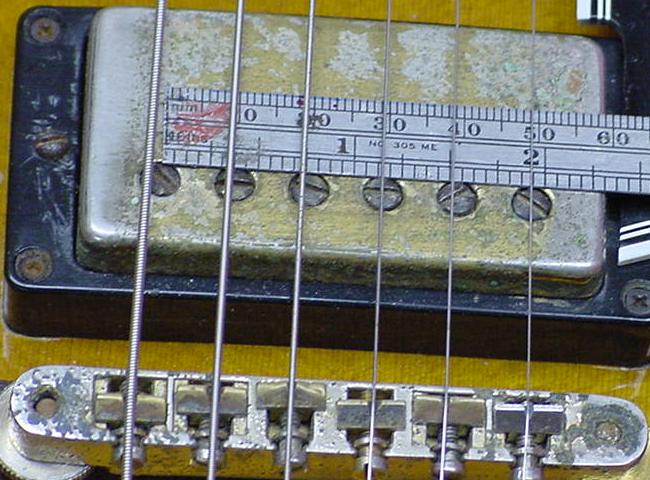
The hollowbody jazz guitars often used a slightly different PAF in
the neck position which had different (narrower) string spacing, where the
bridge position jazz PAF was identical to the neck & bridge PAF in say a Les Paul Standard.
The models that used this narrow spacing neck PAF was the Byrdland,
ES-350T, L-5CE, S-400CE and some Barney Kessel models.
The distance on a narrow PAF from center to center of the two
"E" adjustable poles is 1 13/16", compared to 1 15/16" on the "normal" spaced
PAF pickup. Also since most of these models had gold plated parts, the narrow
spaced PAFs would be gold plated (except on some Barney Kessels).
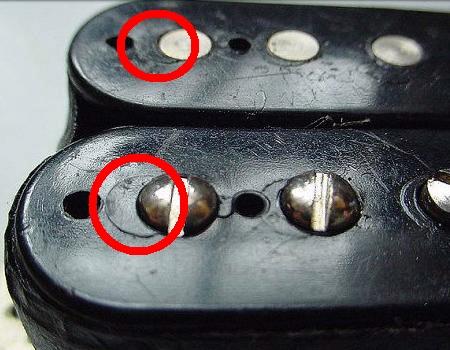
If the pickup cover is removed from a
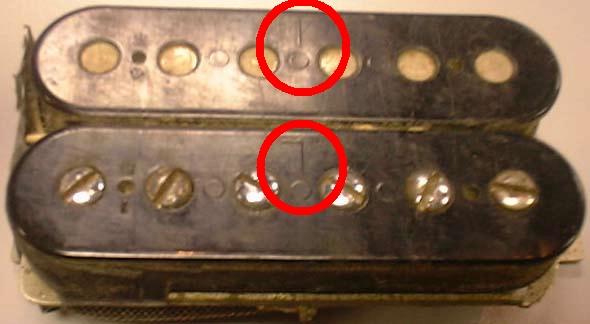
narrow spaced PAF pickup, the "normal" pole position tooling marks can be
seen on the narrow spaced PAF pickup.
A narrow spaced neck position PAF on a 1959 L-5CES.
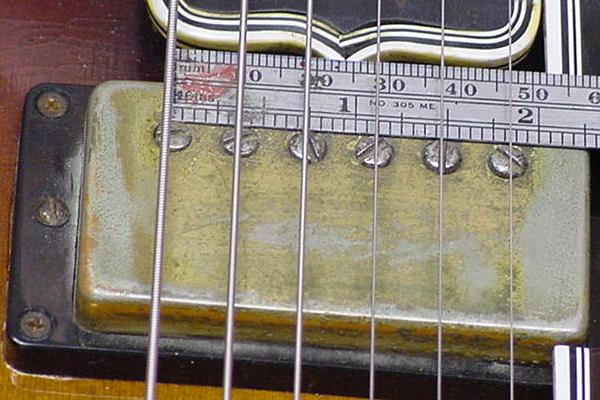
A "normal" spaced bridge position PAF on a 1959 L-5CES.
The internals of a narrow spaced neck position PAF pickup.
Notice the tooling marks (circled in red) where the "normal" spaced poles would be.
Pic by D.Paetow
PAF Guts (Covers, Decals, Bobbins, Tooling Marks, etc).
First and foremost, never ever remove the cover from an original PAF
pickup, unless you have a darn good reason. There is just no need for
this, and it really makes the pickup "unoriginal" if you remove the
metal cover. If you are dying to see the color of the pickup bobbins,
just remove one of the underside bottom mounting screws and look
in the hole, instead of removing the pickup cover.
Early P.A.F. pickups as used on the 1956 console steel guitars and 1957 Les Paul Standard had brushed stainless steel pickup covers (brushed to make them look nickel plated). This quickly changed to brass covers with a nickel plating. If the cover was gold, the brass was first nickel plated and then gold plated. Early PAFs also have four brass bobbin attachment screws, instead of steel screws. Also the early PAFs with stainless covers often did *not* have a PAF decal on the bottom (so some 1957 Gibson guitars will have unlabeled PAF pickups with brushed stainless covers).
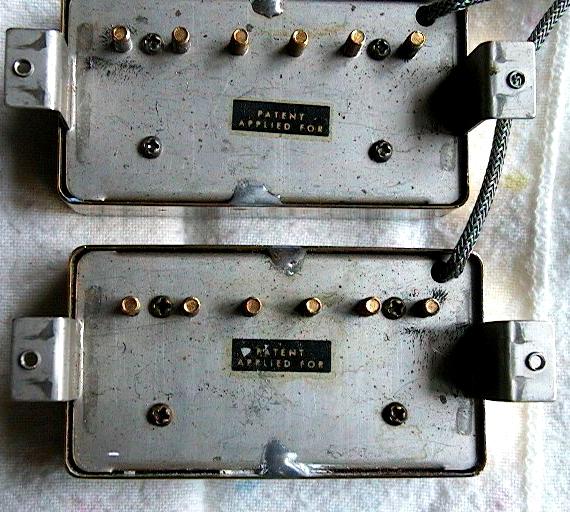
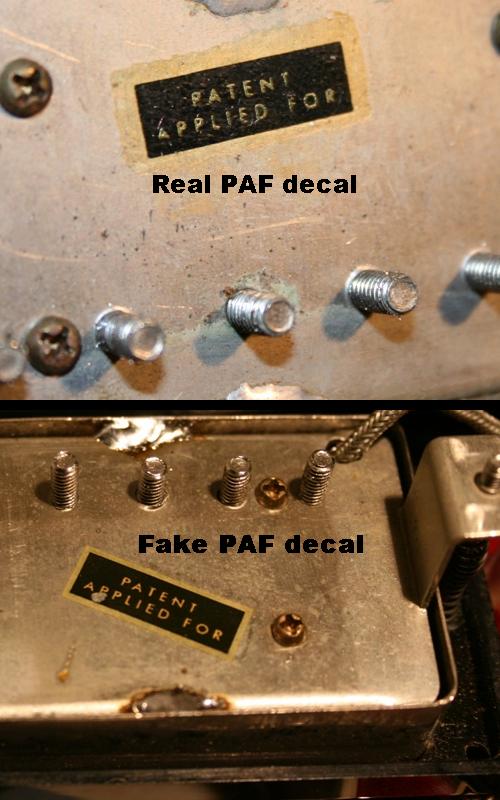
With that in mind, the first picture shows the bottom side of the PAF pickup, and the decal that declares the humbucking is "Patent Applied For" (PAF). Note the lettering and style of the decals. The lettering is gold, and sometimes the gold does turn green just a bit. The clear edge decal border around the black PAF decal has a slight green tint to it. Again remember very early stainless steel covered PAF pickups will not have any decal on the bottom. Also note the untouched solder joints holding the pickup cover to the pickup base plate. And the single stranded black cloth-covered lead wire, which is shielded with a braided metal wrap.
The "L" shaped tooling marks can be clearly seen on the feet of these PAFs.
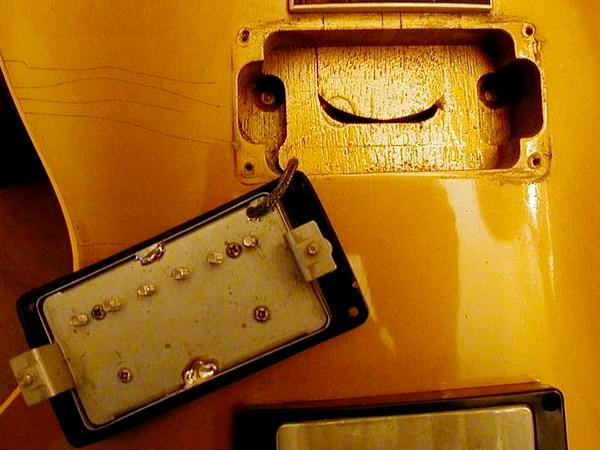
Here is a pre-PAF sticker 1957 Les Paul goldtop pickup. Notice the
lack of a PAF sticker, which is common for many 1957 PAF guitars.
Picture by XO.
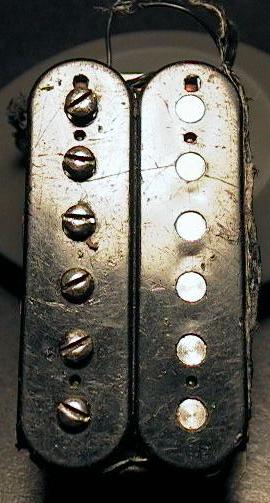
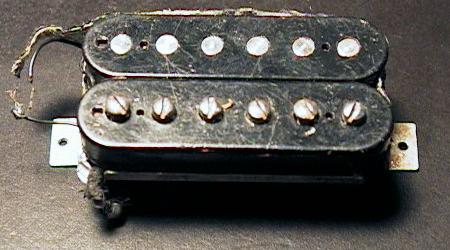
Double black bobbin PAF. Note the "circle around the square" tooling hole at the top of both bobbins. Notice the hole on the adjustable pole piece side has a smaller circle around it. The non-adjustable side always has a slightly larger circle. Reissue pickups copy this somewhat but don't copy it just right. Also on newer pickups the circle and square is very clean and crisp. On original PAFs they are less perfect. Also look inside the bobbin holes for the bobbin wire color. It should be a copper wire with a purplish hue. The color of the wire is very important, and it shouldn't look too clean (the pickup is 40+ years old!)
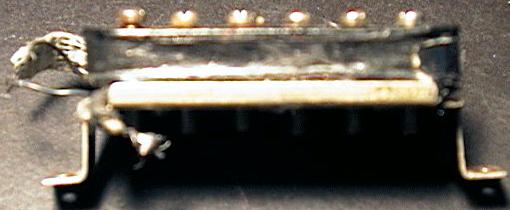
One bobbin removed on an late PAF pickup, showing the magnet.
The length of this magnet changed in summer 1961 from 2.5" to around 2.25"
(decreased in length 1/8 to 1/4").
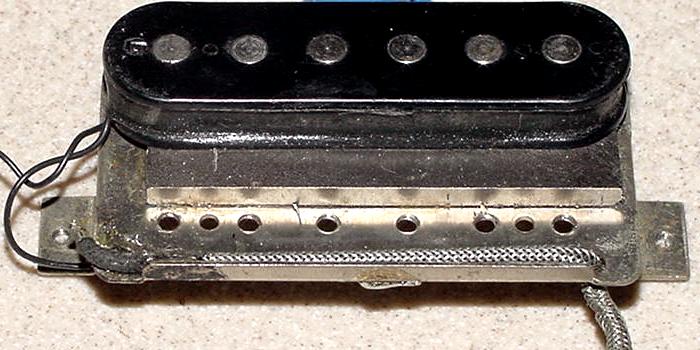
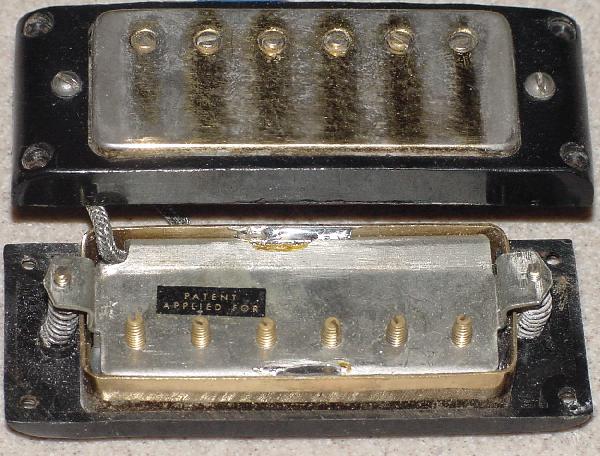
Gibson also had PAF mini-humbuckers, used on Epiphone guitars in 1960 to 1962.
Zebras PAF Pickups.
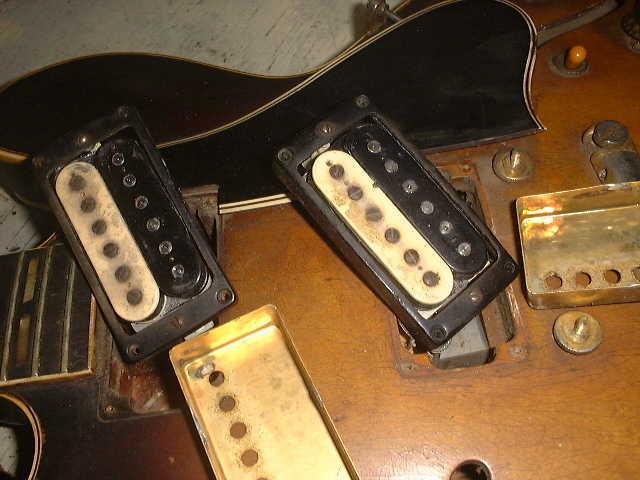
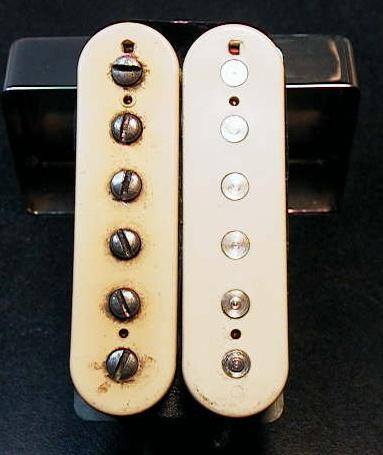
Zebra PAF pickups. Starting in early 1959, PAF pickup bobbins started to be (randomly) white. On all zebra (half black, half white) PAF pickups, the white bobbin is almost always the non-adjustable bobbin (though there are rare exceptions).
"Normal" zebra PAFs with the black bobbins with adjustable poles.
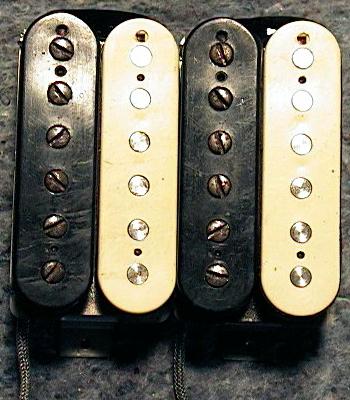
"Rare" zebra PAFs with the white bobbins with adjustable poles.
Picture by 58burst (or johnnyjellybean?)
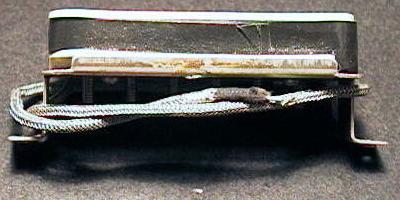
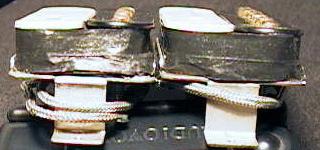
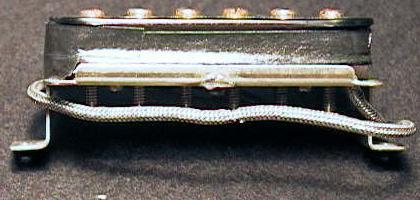
This picture shows the tape that is used to wrap the bobbins.
It is *not* a PVC plastic tape, but instead is a black paper-ish adhesive tape.
It should not look like it was ever removed, unless the pickup
was rewound (rewinds are a bad thing).
Double White PAF Pickups.
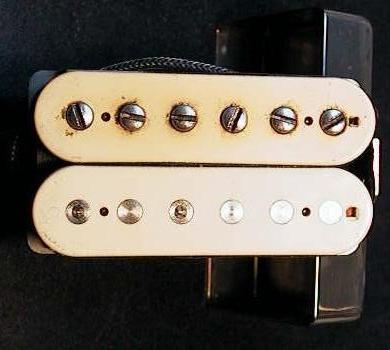
A double-white PAF pickup. Again in 1959 white bobbins were fairly common, and some pickups were Zebras (as seen above) and some were "double whites" (as seen below). For example, on Les Paul Standards around serial number "9 0600", the plastic humbucking pickup bobbins can often be white. By mid-1960 the use of white PAF bobbins ceased, and PAF pickups again because all black ("double black"). Again notice the "circle around the square" tooling holes at the top of both white bobbins.
Thanks as many pictures by GW Dean, BurstMeUp.
PAF Pickup Detail Summary.
Here's a summary of Humbucking pickups. Just be aware that changes occur over
time. When I say "1965" that does not mean January 1, 1965. All changes transition
in as parts are used up and replaced by new parts.
- Late 1956: original console steel guitar PAF pickups, 8 strings.
- February (or so) 1957 to Fall 1957: Original guitar PAF. Long magnet, *no* PAF sticker, purple bobbin wire, black leads on both coils, brushed stainless steel covers, phillips screws on base, ohms can run from 7k to high 9k ohms, black bobbins PAF style bobbins ("circle in a square"), "L" shaped tool marks on feet. PAFs were first installed on steels in late 1956. The long magnet dimensions are 2.5" long, .5" wide, about .125" thick.
- 1957-1958: Generally this era of PAF guitar pickups had resistance around 7k to 8k ohms.
- 1959-1962: Generally this era of PAF guitar pickups had a resistance of around 8k to 9k ohms.
- Fall 1957-1961: Original PAF, long magnet, "Patent Applied For" (PAF) sticker, purple bobbin wire, black leads on both coils, nickel covers, phillips screws on base, ohms can run from low 7k to high 9k ohms, black bobbins PAF style bobbins ("circle in a square") until 1959 cream colored pickup bobbins are often seen, 'L' shaped toolmarks on feet.
- 1961-1962: last PAF pickup style. Short magnet (starting July 1961), PAF sticker, purple wire, black leads on both coils, nickel covers, phillips screws on base, both bobbins are black again, PAF style bobbins ("circle in a square"), "L" toolmarks on feet. The short magnet dimensions are 2.37" long, .5" wide, about .125" thick (decreased magnet length 1/8").
- 1962 to mid-1965: Early "patent no." sticker pickups with PAF specs: nickel cover,
short magnet, PAF style bobbins ("circle in a square"),
phillips screws on base. Plastic on bobbins more durable and bobbins are
flat (PAF style pickups often have bowed pickup bobbins), "L" toolmarks on feet,
plain enamel wire and double black leads.
Note the last version of the PAF (1961-1962) is basically identical to the nickle plated 1963 to 1965 Patent# pickup (and on guitars with gold parts, probably as late as 1967 Patent# pickups are equivalent to 1961-1962 PAFs, since Gibson used less gold plated parts and inventories lasted longer). Because the wire coatingchanged around 1966 (and some other changes listed above), technically the later Patent# pickups are different than the 1963 Patent# and late PAF pickups (though the tone is very similar). Also keep in mind gold plated PAFs used in archtop electric guitars (especially varitone guitars) can be seen as late as 1965 (yes PAFs as late as 1965!) The reason for this was simple - Varitone guitars had gold plated pickups with one pickup having a reversed magnet. This style of pickup was used far less than a nickel plated pickup. Hence these gold plated varitone equipped archtops are sometimes seen with one or two PAF pickups into 1965.
- late 1965: Late "patent no." sticker with no T-top, covers are now chrome, bobbin lead wires change to one black and one white, orange poly coated wire, one white bobbin lead, short magnet, phillips screws on base, "L" toolmarks start to disappear off feet (but can be seen as late as 1972), ohms run pretty consistent at 7.5k ohms.
- Second half of 1967 to 1975: Patent number pickups with plain enamel wire and white and black leads, T-top, "patent no." sticker, no longer has hole in bobbin showing wire, orange wire, short magnet, screws on bottom of base are usually slotted but could be phillips. "L" toolmark can be seen on early T-top pickups.
After PAF pickups were gone, the patent# pickups were next and used from 1962 to 1965. Then late 1965/1966 the wire coating changed from enamel to poly. From 1968 to 1975 the next Gibson humbucker is known as the "T bucker" or "T top". They are called this because of a "T" that is part of the molding on the front of the two pickup bobbins. These also had the decal with "Patent No 2,737,842" (still the patent number of Les Paul's trapeze tailpiece). The only way to see the "T" is to remove the pickup cover. A small change in late patent# pickups was white PVC bobbin wires instead of black (black was used on pre-1966 humbuckers). Also T buckers can use either slot or phillips head screws to hold the bobbins to the base plate.
When buying used Gibson pickups, many people will buy the "Patent No." style with an unopened nickel-plated cover. This pretty much guarentees you'll get a "good" pickup at a fair price (opposed to buying a PAF pickup with the "Patent Applied For" decal intact, which sell for more money). Sonically the nickel plated covered patent# pickups are excellent values, as they are very similar in sound to a real PAF pickup (but are much less expensive). Note if you buy a chrome covered Gibson pickup, it's a crap shoot as to what's inside - it could be either a T-bucker or not (but chances are good it will be a T-Top). For this reason I would generally avoid chrome covered Gibson humbuckers (unless they are really inexpensive), as the odds are against you in hopes of finding a non-Ttop.
Here's the 1962 to 1965 style "Patent Number" pickup, which followed the PAF.
Note the "L" toolmarks are still present.
The later "T bucker" T-top pickup used from 1976 to the 1980s.
PAF Forgeries.
PAF forgeries are fairly common. Aside from the physical characteristics of the pickups, through the years PAF decals have been re-created. These are usually easy to spot though. For example, below is a picture of real versus fake PAF decals. The original PAF decals will have clear yellowed borders (because the original decals have a coating of clear lacquer over the decal), and often the fakes have a gold border. Also the font and letter clarity are different. Pics by AtomEve.
Top: real Gibson PAF decal.
Bottom: fake PAF decal.
PAF Pickup Rings.
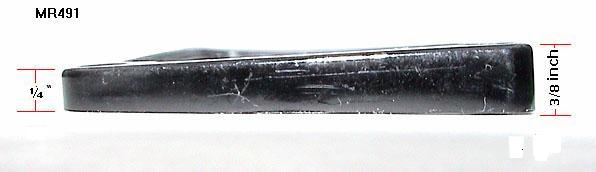
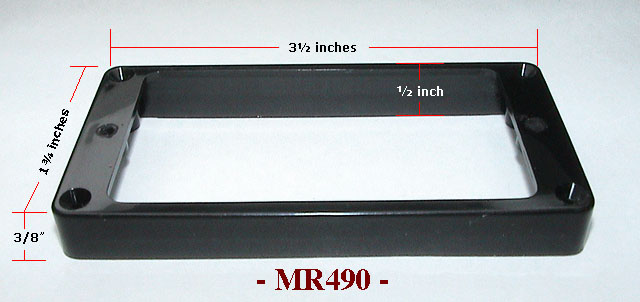
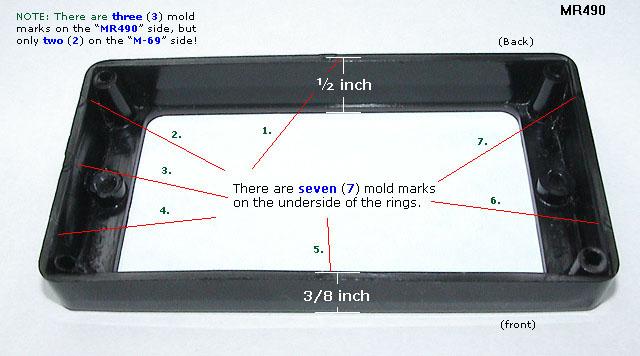
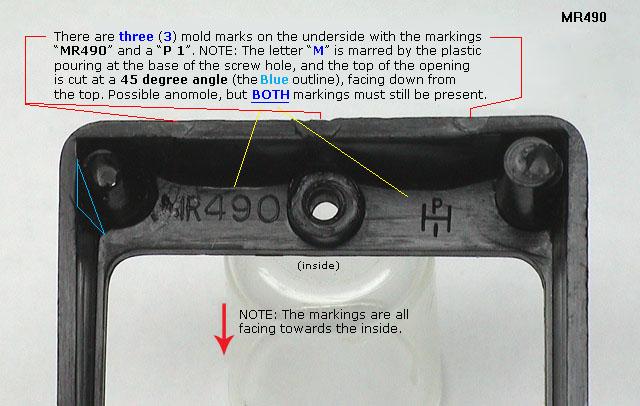
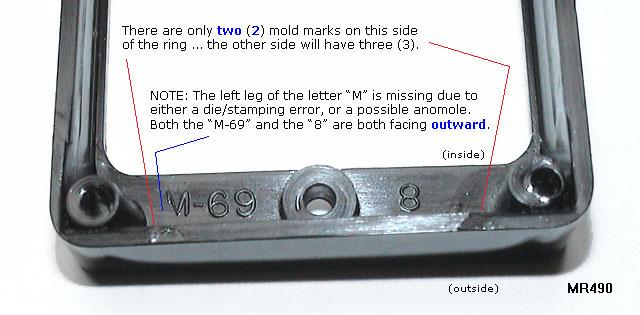
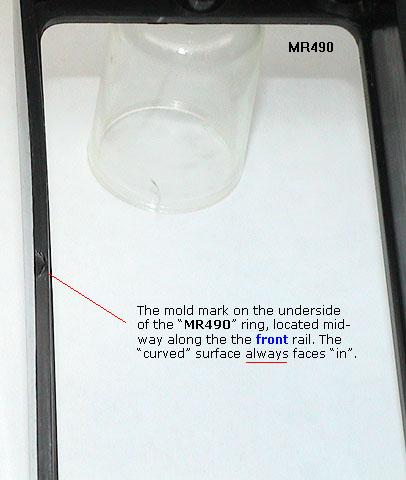
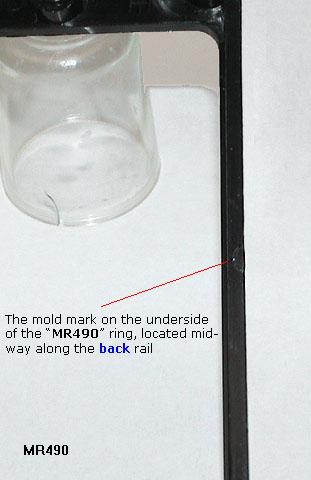
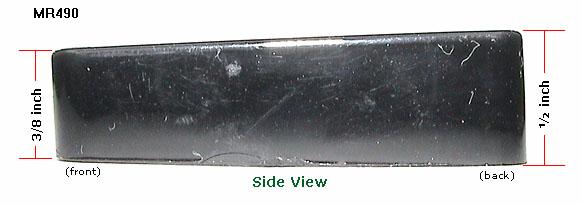
The rings used for PAF pickups are unique too. Often call M-69 (or MR490 or MR491 which identifies the neck or bridge ring), because of the mold markings underneath the pickup ring. All PAF pickups should have a black or cream M-69 pickup ring. Neck pickup rings (thinner) are MR491, as molded on the underside. Bridge pickup rings (thicker) are MR490. Note there is no physical difference between cream and black rings (other than the color) - they are exactly the same (though black is far more common as cream rings were only used on Les Pauls and ES-295 guitars and some steel guitars). Pictures and info thanks to BurstMeUp.
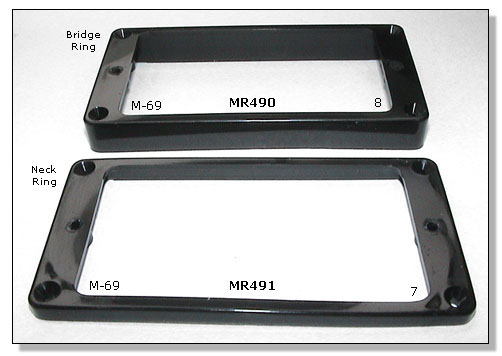
1959 neck pickup MR491 ring pictures by BurstMeUp.
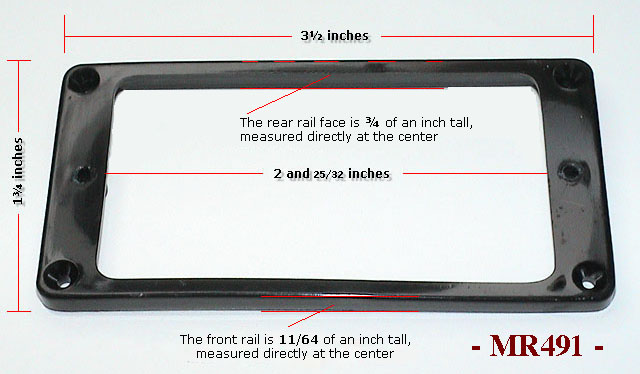
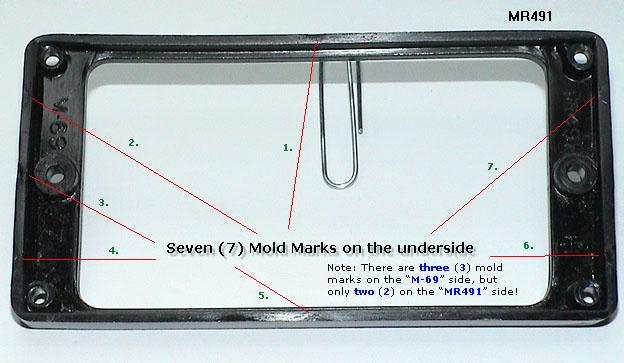
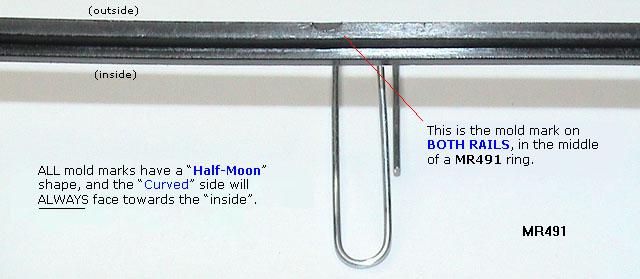
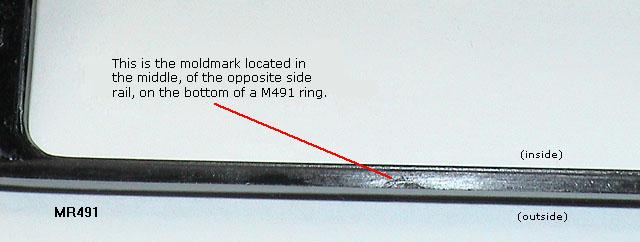
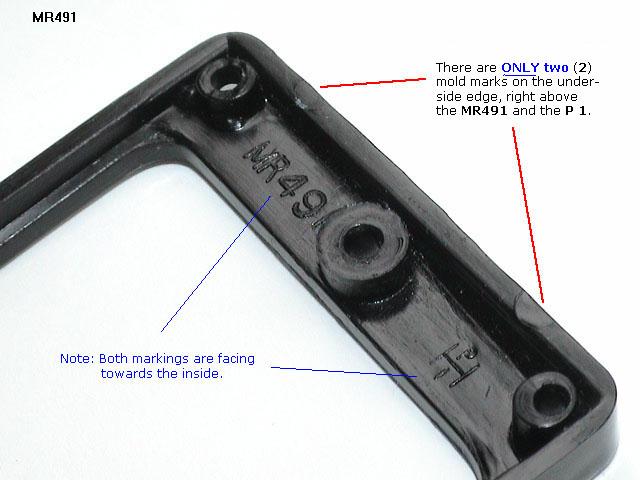
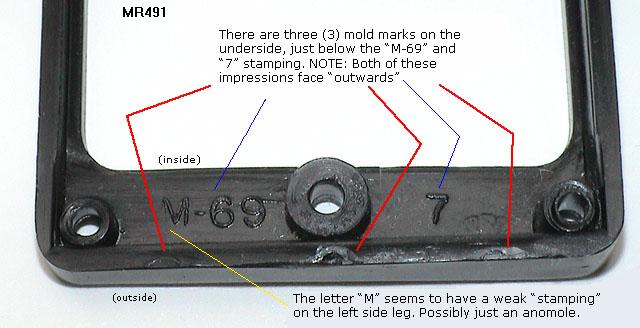
1959 bridge pickup MR490 ring pictures by BurstMeUp.
M-69 Pickup Ring Forgeries.
Some resourceful people in the U.K. have been making
reproduction pickup rings. These often get sold as
the "real thing". So keep an eye out for these. There
are some things that do identify these reproduction rings.
First it's best to understand how reproduction rings are made
using new Urethane plastic.
Urethane cast parts are made using a RTV silicone rubber mold. This is created by putting a silicone mold around an original part. Once the silicone has cured, the mold is opened and the original part removed. The mold cavity can now be filled with a liquid urethane resin which cures to make the reproduction pickup ring. This is a great process for reproduction because the mold duplicates the exact features of the part, even down to scratches on the surfaces of the part.
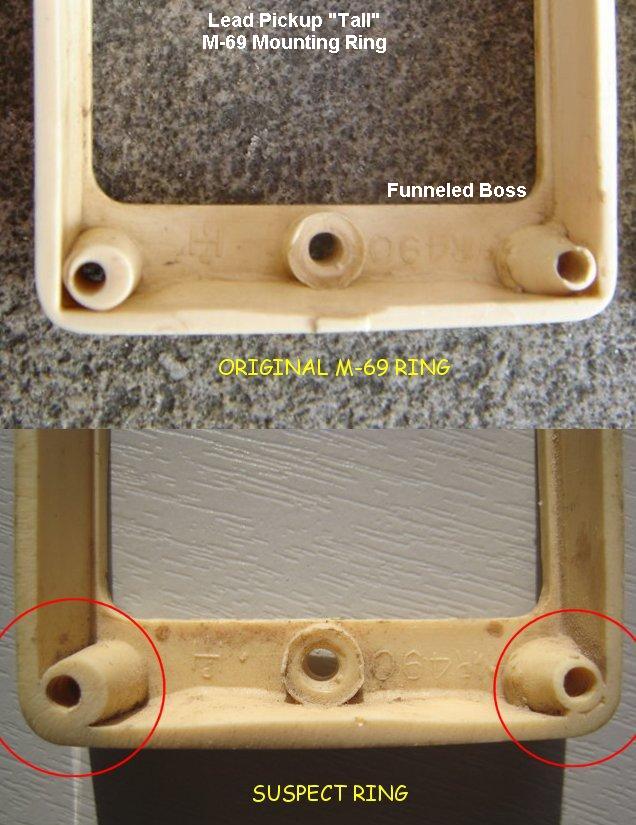
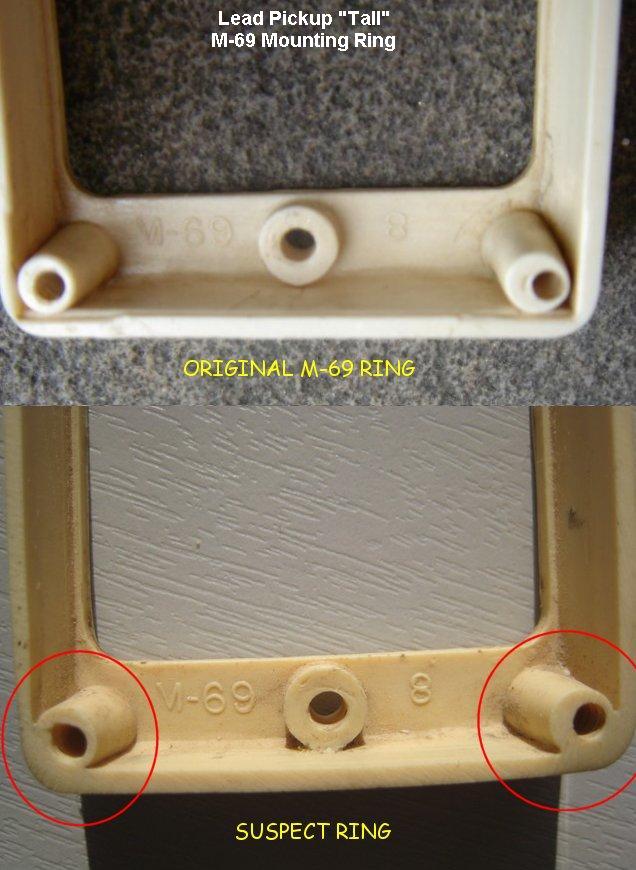
The M-69 rings have certain features that would be very difficult to create in a machined steel mold. For example the one "funneled" screw boss mount on the tall lead pickup M-69 rings. The reason that one particular screw boss on the tall ring is "funnel-shaped" is probably due to a repair to the original steel mold. Every original M-69 has the same feature, so the repair was made when the mold was new. Most likely the toolmaker screwed up the machining of the boss feature in the mold cavity and then repaired it by welding the cavity steel and hand-grinding the hole.
When the suspect (new) rings are made, the silicone mold that was used was either not well made to start, or else it was used multiple times. This can be seen by the fine webs of silicone that create the crevices around the bosses eventually broke down. RTV silcone molds are typically good for about 10-20 parts at which point the silicone becomes brittle and new molds must be made.
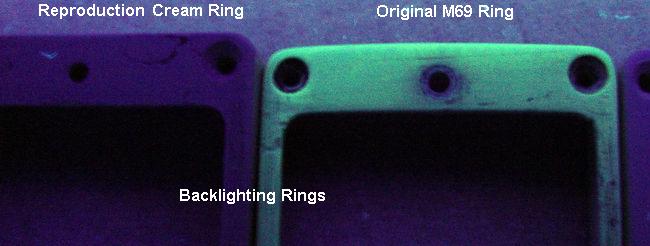
Using this knowledge and a blacklight (new rings don't glow the same under blacklight as old original rings), it shouldn't be too difficult to tell a new reproduction M69 ring from an original. Often to hide the mounting boss reproduction issues, the bottom of the M69 may be sanded on a belt sander. Gibson would do this sometimes too by the way, to made "medium height" rings for many of the ES guitar models. The sanding process fills the gap between the screw boss and where it meets the ring. This makes identifying the ring forgery more difficult as the screw boss shape is distorted (and becomes attached to the ring's sidewall) because of the sanding and the friction heat.
Pictures by DanElectro:
Picture by KtheSheep:
Back to the Gibson General Info
Back to the Table of Contents
Copyright all rights reserved.